
What Is an Air Dome? Guide to Air-Supported Structures
What Is an Air Dome? Guide to Air-Supported Structures
What Is an Air Dome? A Complete Guide to Air-Supported Structures in India
If you've driven past a sports complex lately and noticed a huge, smooth, balloon like structure sitting where an open field used to be, you've seen an air dome. They're popping up all over India now, at cricket academies, badminton centres, warehouses, even exhibition grounds, and if you've ever wondered how a building made of fabric actually holds itself up without a single column inside, you're about to find out.
This guide walks through what an air dome actually is, how it works, where it is being used across India, and what to think about before you invest in one. It comes from the team at LUCKY-TECH Membranes, one of India's leading Fabrics Manufacturers and Supplier in India, so it reflects the questions we hear most often from people planning these projects. No jargon, no fluff, just the things you would actually want to know before making a decision.
Get In TouchWhat Exactly Is an Air Dome
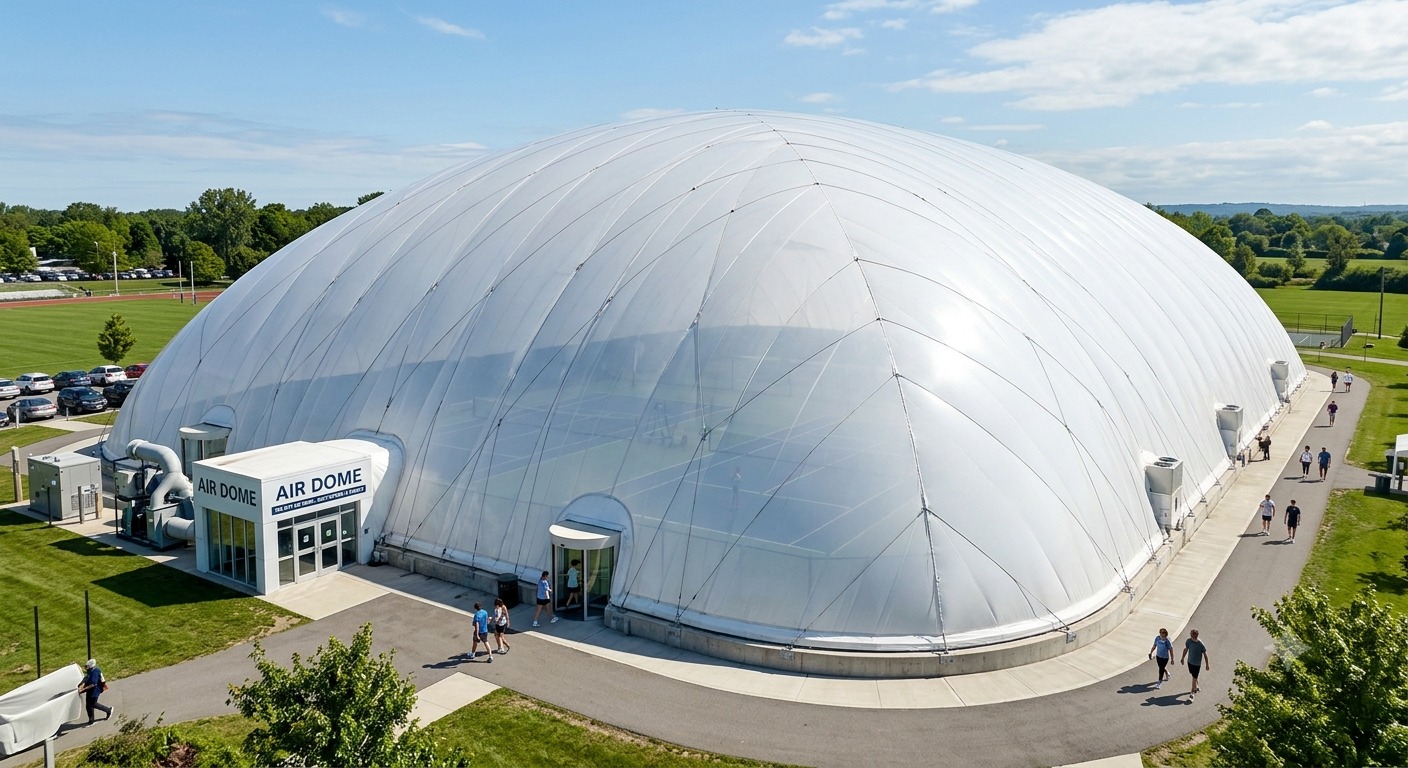
An air dome, also called an air supported structure, is a large, dome shaped building made from a specially engineered fabric membrane that is held up entirely by internal air pressure. That membrane usually comes from a specialist fabric manufacturer rather than being made in house by the company erecting the dome, since the coating and engineering behind it is its own area of expertise. There is no steel skeleton, no support beams, no columns holding up the roof. The air itself does that job.
It sounds almost too simple to work, but it has been used for decades in stadiums, warehouses, and event spaces around the world, and the engineering behind it is actually quite elegant.
The Simple Idea Behind the Engineering
Here is the part people usually find surprising. The pressure difference between the inside and outside of the dome is tiny, barely more than what you would feel walking up a flight of stairs. It does not need to be huge, because it is acting over an enormous surface area. Multiply a small pressure by a large enough area, and you get more than enough force to keep the whole structure rigid and standing.
A blower system, usually more than one so there is always a backup, continuously pushes air into the dome to maintain that pressure. Airlocks at the entrances let people walk in and out without letting the whole structure deflate. It is a closed system, constantly topped up, quietly doing its job in the background.
Why Air Domes Are Catching On in India
A few years ago, air domes were mostly something you would read about in foreign sports magazines. That is changing fast, and there are some practical reasons why.
Indian weather is not gentle. Monsoons flood outdoor grounds for months. Summer heat makes daytime training brutal. Winters in the north bring fog and cold that shut down outdoor practice altogether. An air supported structure sidesteps all of that, creating a controlled, weatherproof space that keeps functioning regardless of what is happening outside.
There is also a cost logic to it. Building a conventional enclosed structure of a similar size, with a steel or concrete roof spanning that kind of open area, is a serious construction project involving foundations, structural steel, and months of work. An air dome gets you a comparable column free space in a fraction of the time, using a fraction of the material.
And because it is fundamentally a fabric structure rather than a permanent building, it also gives you flexibility that concrete never will. It can be relocated, resized for a new site, or reconfigured in a way a poured foundation simply cannot be.
Where Air Domes Are Actually Being Used
The applications are broader than most people expect.
Sports and Training Facilities
This is where air domes have found their strongest foothold. Badminton courts, tennis courts, football and cricket practice nets, indoor athletics, anywhere a facility wants to guarantee training can continue no matter the season. For academies competing to attract serious athletes, being the only facility in the area that trains rain or shine is a real advantage.
Industrial and Warehouse Storage
Not every air dome is about sport. Manufacturers and logistics companies use air domes to create large, clear span covered storage without the time and cost of a conventional warehouse build. When you need a big enclosed space fast, for seasonal stock, raw material storage, or overflow capacity, an air dome can be up and running in a fraction of the time a permanent structure would take.
Events, Exhibitions, and Temporary Venues
Because they can be installed relatively quickly and taken down when no longer needed, air domes also show up as temporary exhibition halls, event pavilions, and pop up venues, spaces that need to look impressive and function well, but only for a defined period.
Air Dome vs Geodesic Dome vs Tensile Structure: What's the Difference?
If you are comparing dome options, it helps to know how they differ at a basic level.
A tensile structure uses a network of cables and rigid supports to stretch fabric into shape. Think of the sweeping fabric roofs you see over stadium entrances or shaded walkways. It is held in shape by tension, not air.
A geodesic dome is built from a rigid framework of triangular struts, clad in fabric or another material. It stands on its own structural strength, the way a regular building does, just in a very different shape. (We have written a separate, detailed guide on geodesic domes if you want to go deeper on that one.)
An air dome, as we have covered, needs no rigid frame at all. Air pressure alone does the structural work.
Each has its place. If you need a permanent architectural feature, a tensile structure or geodesic dome might suit better. If you need the fastest possible large clear span enclosure, especially somewhere that might need to be relocated or resized down the line, an air dome is usually the more practical route.
What Actually Affects the Cost of an Air Dome
We are not going to throw numbers at you here, because honestly, anyone who quotes you a price before understanding your project is guessing. What we can tell you is what actually drives the cost up or down, so you know what questions to ask when you do get a quote.
The biggest factor is simply how much space you need to cover. A small practice court and a full sized warehouse are very different projects. After that, the specification of the fabric membrane matters a lot: thickness, UV and fire retardant treatment, and the quality of the coating all affect both price and how long the structure will last. The blower and pressure control system you choose, including how much backup you want, is another meaningful line item. And finally, site preparation such as anchoring, foundations, and access varies a lot depending on the ground you are building on.
The honest answer to "how much will this cost" is that it depends entirely on your specific project, and a good air dome manufacturer in India should be asking you detailed questions before giving you a number, not the other way around.
Frequently Asked Questions
What happens if the power goes out?
It will not bring the dome down. This is usually the first question people ask, and it is a fair one to lead with. A properly engineered air dome runs on backup blowers, and in most installations a backup power supply as well, so a brief outage does not translate into a sudden loss of pressure. Even if the primary blower stops for a short while, a well built dome is designed to hold its shape and pressure for a meaningful window until power is restored.
Is it safe in strong wind or heavy rain?
Yes, and this is not an add on feature, it is central to how the structure is designed in the first place. The membrane material and the pressure system are both engineered around the wind loads and rainfall levels of the region the dome will actually sit in, so performance in tough weather is part of the specification from day one, not something bolted on afterward.
How long does an air dome actually last?
With the right fabric specification and reasonable upkeep, an air dome is built to run for years of continuous use, not just a season or two. The fabric membrane is really what decides this. Its thickness, coating quality, and UV resistance determine how well it ages, which is exactly why it is worth asking your fabric supplier detailed questions about where the material comes from and how it is treated before you commit.
Can it really be used all year round, not just for one season?
Yes, and for most buyers that is the entire point of choosing one. Since the internal climate stays controlled regardless of what the weather is doing outside, the space remains usable through monsoon, summer heat, and winter fog alike, which is exactly the return on investment sports academies and warehouse operators are looking for.
Is an air dome only useful for sports facilities?
Not even close. Storage, exhibitions, and temporary event venues all rely on the same structure just as often. Its reputation as a sports facility is mostly a matter of visibility, since that is where the technology first became widely noticed in India, but the underlying use case is really any project that needs a large, fast, weatherproof enclosed space.
Choosing the Right Partner for Your Air Dome
If you are weighing up whether an air supported structure makes sense for your sports facility, warehouse, or event space, the fabric membrane is really where the whole decision lives. It is what determines durability, safety, and how the structure performs under India's weather extremes over the years, not just on day one. Working with an experienced fabric supplier from the start makes that conversation much easier.
At LUCKY-TECH Membranes, we manufacture and supply the PVC and PVDF coated fabric used in air domes and other tensioned structures, through our exclusive partnership with SIOEN Industries. If your team is planning an air dome project,get in touch with us and we will walk you through the right material for your specific structure.
Get Your Free Quote Today!