
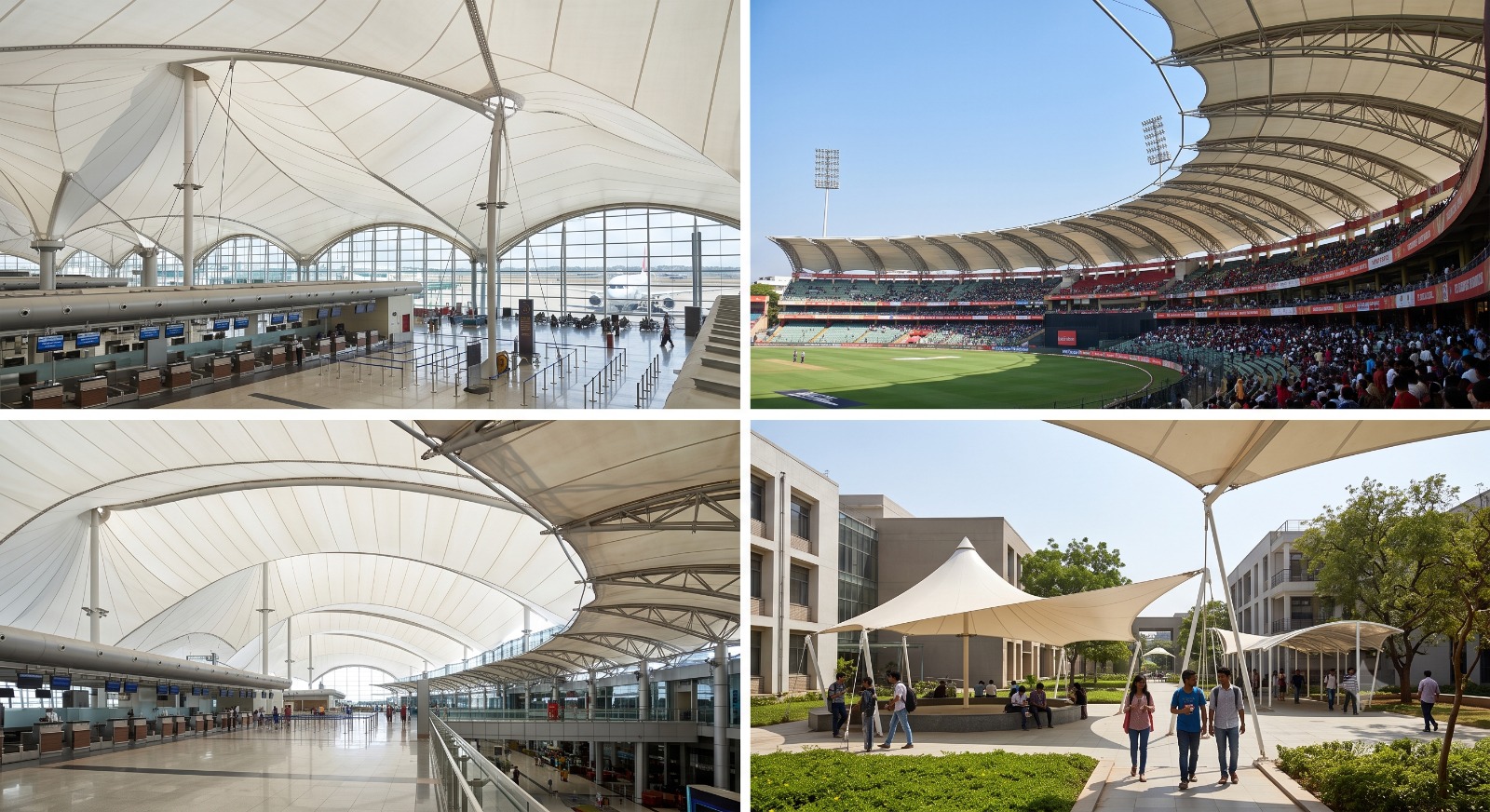
Top Fabric Structure Projects Across India: Universities, Airports and Stadiums
Top Fabric Structure Projects Across India: Universities, Airports and Stadiums
Tensile Structure Projects Across India: Airports, Universities and Stadiums
India's skyline is changing in a quiet but noticeable way. Walk through a major airport terminal today, sit in a university courtyard, or watch a match at a modern stadium, and there is a good chance you are standing under a stretch of engineered fabric rather than concrete or steel sheeting. This shift is not just about looks. It is about how architects and facility owners are solving real problems around heat, crowd movement, and construction timelines using tensile structure projects India has increasingly come to rely on.
In this post, we will walk through where these structures are showing up, why they work so well in Indian conditions, and what makes a good tensile membrane fabric installation stand the test of monsoons, heat waves, and years of daily use.
Get In TouchWhy Fabric Structures Are Gaining Ground in India
A few years ago, tensile fabric was mostly seen at exhibitions or temporary event setups. That has changed. Institutions now choose fabric roofing as a permanent architectural solution, and the reasons are fairly practical:
- Fast installation compared to conventional roofing
- Natural light without heavy cooling loads
- Lower structural weight, which reduces the load on foundations
- Long design life when paired with quality fabric membranes
These benefits, combined with India's climate extremes, have pushed the demand for fabric architecture case studies that show real, working examples rather than just renderings.
Airport Tensile Roof Projects Changing the Passenger Experience
Airports were among the earliest adopters of large scale tensile roofing in India, and it is easy to see why. Terminal buildings need wide, column free spans to manage passenger flow, baggage handling, and security checkpoints without visual obstruction.
An airport tensile roof does more than just cover the space. It filters harsh daylight into a soft, even glow across the terminal, cutting down on artificial lighting during the day. Several regional and metro airports across India have adopted PTFE and PVDF coated membranes for their departure halls, forecourts, and canopies connecting parking areas to terminals.
What stands out in these projects is how the fabric roofing handles India's summer heat. A well engineered tensile membrane reflects a large portion of solar radiation while still letting diffused light through, keeping the terminal comfortable without pushing air conditioning systems to their limit.
University Tensile Structure Projects Reshaping Campus Life
Educational campuses across India are another space where tensile fabric has found a natural home. A university tensile structure is often used for open air amphitheatres, walkways connecting hostels to academic blocks, sports courts, and central courtyards where students gather between classes.
Unlike a traditional shed roof, tensile canopies on campuses tend to have a sculptural quality. Architects use curved and layered fabric forms to create a visual identity for the institution, something that photographs well and becomes part of the campus brand. At the same time, these structures serve a very functional purpose: shielding students from direct sun during peak hours and keeping outdoor spaces usable through most of the year.
Many of these projects rely on suppliers who understand both the design intent and the material science involved, which is where a dependable Fabrics Manufacturers and Supplier in India becomes essential to the success of the build.
Stadium Fabric Canopy Structures for Large Crowds
Sports infrastructure is perhaps where tensile fabric makes the strongest case for itself. A stadium fabric canopy needs to cover thousands of seats, resist wind uplift, and still allow enough light through for grass pitches to stay healthy.
Cricket stadiums, multi purpose sports complexes, and newer indoor arenas across Indian cities have adopted tensile canopies for exactly these reasons. The fabric spans large distances with minimal support columns, which means fewer obstructed views for spectators. During heavy rain, the taut membrane sheds water quickly along its curved profile, avoiding the pooling issues that flat roofs often struggle with.
These stadium projects are also a good showcase of how far tensile engineering has come in India, with local fabrication and installation teams now handling spans that were once only possible with imported expertise.
What Makes a Fabric Structure Project Successful
Looking across these three sectors, airports, universities, and stadiums, a pattern emerges. The projects that age well share a few common traits:
- Careful site specific wind and load calculations before design finalization
- Use of high grade tensile membrane fabric rated for UV exposure and tensile strength
- Skilled installation teams who understand tensioning and anchoring
- Regular maintenance schedules to check for wear, especially around seams
This is also where the choice of supplier matters. Lucky-Tech Membranes has been involved in projects across these categories, working with architects and contractors who need reliable fabric membranes that hold up to Indian weather without losing their tension or clarity over time. A good manufacturing partner does not just supply material, they help troubleshoot design challenges before the structure ever goes up.
The Road Ahead for Fabric Architecture in India
As more cities invest in public infrastructure, the appetite for lightweight, weather resistant, and visually striking roofing solutions is only going to grow. Fabric structures fit naturally into this demand because they combine speed of construction with long term durability, something traditional materials often cannot match at the same cost.
Whether it is a passenger terminal, a campus courtyard, or a stadium bowl, the underlying story is the same. Good engineering, quality material, and an experienced supplier can turn a simple stretch of fabric into infrastructure that serves people for decades.
FAQs
Q1. What is a tensile membrane structure?
It is a roofing or covering system made from stretched, high strength fabric held in place by cables and support structures, commonly used for its light weight and large span capability.
Q2. Why are airports using fabric roofs instead of concrete?
Fabric roofs allow wider column free spans, better natural light, and faster construction, all of which suit the scale and functional needs of modern airport terminals.
Q3. How long does a tensile fabric structure last?
With good quality material and proper maintenance, most tensile membrane installations last between 15 to 25 years, depending on the fabric grade and local weather exposure.
Q4. Are fabric structures safe during heavy rain or storms?
Yes, when designed correctly with proper tensioning and anchoring, these structures shed water efficiently and are engineered to handle regional wind loads.
Q5. Who supplies tensile fabric material in India?
Several manufacturers work in this space, with companies like Lucky-Tech Membranes supplying fabric membranes and technical support for projects ranging from stadiums to university campuses.
Get Your Free Quote Today!