PVDF Fabric for Long-Life Geodesic Dome Covers: What Makes It Last
PVDF Fabric for Long-Life Geodesic Dome Covers: What Makes It Last
A geodesic dome looks simple from the outside. Many triangles come together to form a smooth, round shape. But the part that faces the sun, rain, wind and dust every single day is the cover. If the cover fails early, the whole dome suffers. That is why the choice of fabric matters so much.
Picking a roof sounds simple until you start comparing options. Glass looks grand. Polycarbonate sounds tough. Tensile membrane fabric looks modern and light. Each one has a place, but each one behaves very differently once it is on site.
Get In TouchIn this blog, we compare the three in plain words. We also look closely at PVC fabric, because it is the base of most tensile membrane roofs you see today. By the end, you will know which roofing suits your project and what to ask a Tensile Fabric Manufacturer before you decide.
What to Look at Before You Choose a Roof
Before comparing materials, be clear about what the roof must do. Ask yourself a few simple things:
- How much span do you need to cover?
- How much natural light do you want inside?
- Will the roof face heavy rain, strong sun or wind?
- How important is the look of the roof?
- How easy should it be to maintain over the long run?
Your answers will point you to the right material faster than any brochure.
Glass Roofs: Clear and Classy, but Heavy
Glass gives a clean, premium look and lets in a lot of light. It is a good fit for atriums, skylights and showpiece entrances where clarity matters most.
But glass has limits. It is heavy, so the support below must be strong enough to carry it. Large panels need careful handling during transport and fitting. Glass is also rigid, so it cannot bend to follow curved or free-form shapes. And if it breaks, the result can be messy and unsafe. For a large, wide-span roof, glass quickly becomes a demanding choice.
Polycarbonate Roofs: Tough and Practical
Polycarbonate sheets are far lighter than glass and handle impact better. That is why you see them over walkways, sheds, small canopies and skylights. They are easy to cut and fit, and they let diffused light through.
Still, polycarbonate sheets are best for simple, flat or gently curved layouts. Over time, the surface can lose its clear look, and joints between sheets need regular attention. For big, flowing roof shapes, sheets start to feel limiting.
Tensile Membrane Fabric: Light, Flexible and Made for Big Spans
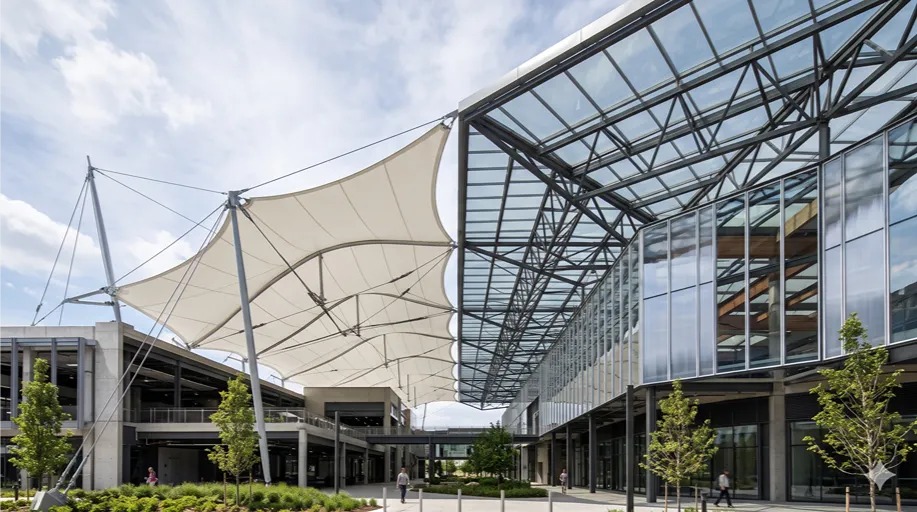
A tensile membrane roof uses a coated fabric that is pulled tight over a supporting frame. The tension in the fabric is what gives it strength and shape. Because the fabric is so light, a membrane roof can cover wide areas without a heavy load on the supports.
This is where tensile roofing stands apart:
- Freedom of shape. Cones, waves, arches and curves are all possible. Glass and polycarbonate cannot match this.
- Light weight. Less load means simpler support design.
- Soft, glare-free daylight. The fabric spreads light gently, so spaces feel bright without harsh glare.
- Quick, clean making. Fabric panels are cut and welded to exact size in a controlled workshop, then delivered ready to fit.
- Wide use. Car parking shades, walkways, stadium covers, entrances, event spaces, hangars and more.
The fabric you choose decides how well the roof performs. That is why the next two sections matter.
Why PVC Fabric Is the Heart of Tensile Roofing
PVC-coated fabric is the most widely used material for tensile membrane roofs, and for good reasons.
It starts with a strong woven polyester base. This base carries the load. A PVC coating is then applied on both sides. The coating protects the base from rain, dust and everyday wear, and it makes the fabric waterproof.
Here is what makes PVC fabric so useful:
- Waterproof and weather resistant. The coating keeps water out and handles sun, wind and rain well.
- Strong yet flexible. It can be stretched, shaped and tensioned without losing its form.
- Weldable. PVC fabric can be joined by heat welding, which creates clean, strong seams. This matters a lot when making large roof panels.
- Easy to clean. Dirt does not cling easily to a well-finished PVC surface, so regular washing is usually enough to keep it looking fresh.
- Wide colour choice. You can match the roof to your building or brand.
- Light and easy to handle. Panels are simple to fold, carry and fit.
This is why a trusted PVC Fabric Manufacturer in India is such an important partner for any tensile project. The quality of the coating, the strength of the base and the finish of the surface all affect how the roof looks and performs.
PVDF Coating: An Extra Layer of Protection
For roofs that must keep their clean look under strong sun and dust, PVDF-coated fabric is a popular choice. PVDF is a protective top finish applied over the PVC-coated fabric. It forms a smooth, tough surface that resists dirt and helps the fabric stay clean and fresh in outdoor conditions.
Think of it this way. PVC gives the fabric its strength, flexibility and waterproofing. PVDF adds a hard-working surface on top. Together, a PVC & PVDF Fabric manufacturer can supply a fabric that suits everything from a simple shade to a landmark roof.
Tensile Fabric vs Glass vs Polycarbonate: A Simple Comparison
Weight. Glass is the heaviest. Polycarbonate is lighter. Tensile fabric is lighter still, which keeps the support design simple.
Shape. Glass is rigid and polycarbonate suits flat or mildly curved layouts. Tensile fabric can follow bold, flowing forms.
Light. Glass is clear and sharp. Polycarbonate gives diffused light. Tensile fabric gives soft, even daylight that is easy on the eyes.
Span. For wide, open areas, tensile fabric is a natural fit, because the fabric is pulled tight across the space with fewer heavy parts.
Safety. Glass can shatter. Fabric does not break into sharp pieces, which makes it a calmer choice over busy public areas.
Fitting. Fabric panels are made in a workshop to exact size, so the work on site stays clean and organised.
Look. Glass looks crisp and formal. Polycarbonate looks simple and functional. Tensile fabric looks modern, light and sculptural.
So, Which Roofing Should You Choose?
There is no single winner for every project. Here is a simple way to decide:
- Choose glass when you need full clarity and a formal, premium look over a small, well-supported area.
- Choose polycarbonate for simple sheds, walkways and small canopies where ease of fitting matters most.
- Choose tensile membrane fabric when you want a large span, a striking shape, soft daylight and a light roof that does not need heavy support.
If your project is big, curved or meant to stand out, tensile membrane fabric usually gives you the most freedom. And once you pick it, the next big decision is the fabric supplier.
What to Ask a Tensile Fabric Manufacturer
Not all coated fabrics are the same. Before you finalise, ask these questions:
- Is the fabric PVC, PVDF-coated, or both, and is it suited to my roof?
- How is the fabric welded, and how are the seams checked?
- Can the panels be cut and made to my exact drawings?
- Can you supply the colours and finish I need?
- Where does the base fabric come from, and what quality checks follow?
Clear, confident answers to these questions tell you a lot about the partner you are dealing with.
Why Choose LUCKY-TECH Membranes for Your PVC and PVDF Fabric
At LUCKY-TECH Membranes, we work with PVC and PVDF coated fabric for tensile roofing and many other uses. Our base coated fabric is engineered by SIOEN Industries of Belgium, a name known across the world for technical textiles. We then design, cut and weld it in-house to your specification. Our setup includes Zünd cutting machines and Forsstrom high-frequency welding machines, so each panel is made with care and precision. With a team of 300+ professionals, we handle the work from fabric selection to finished membrane panels.
Whether you are a dealer, a contractor or a business planning a new roof, our team can guide you on which PVC or PVDF fabric suits your project. If you are looking for a dependable Tensile Fabric Manufacturer and a trusted PVC Fabric Manufacturer in India, get in touch with LUCKY-TECH Membranes and tell us what you are building. We will help you choose the right fabric for the job.
Get Your Free Quote Today!