
Tensile Fabric Explained: Material, Structure & Roofing Uses
Tensile Fabric Explained: Material, Structure & Roofing Uses
Walk past any modern stadium, airport terminal, or open-air market, and there's a good chance you're looking at tensile fabric without realising it. Those sweeping, curved canopies that seem to float above a space aren't made of concrete or steel sheeting — they're stretched fabric, pulled taut into shape and held there by cables and steel frames. It looks almost weightless. The engineering behind it is anything but simple.
Get In TouchThis guide goes deeper than the basics. If you're an architect, contractor, or facility planner evaluating tensile fabric for a real project, you'll find everything here: what the material actually is, how tensile structures are engineered, the different structural forms, what tensile roofing demands, what the fabric itself is made of, how to think about design and sourcing, and the questions that come up most often once a project moves from concept to spec sheet.
What Is Tensile Fabric?
Tensile fabric is a high-strength, flexible material engineered to be stretched under tension and held permanently in that shape. Unlike a rigid roof panel that simply sits in place under its own weight, tensile fabric only becomes structurally stable once it's pulled tight — the tension itself is what gives it strength and form.
That's really the defining idea behind the word "tensile." The fabric resists loads — wind, rain, snow, its own weight — by staying in tension across its entire surface, rather than by being thick or heavy. A well-designed tensile membrane spreads stress evenly across the whole surface, which is why these structures can span large open areas with very little material and almost no interior columns.
It's a fundamentally different way of thinking about a roof or wall. A conventional structure is built to resist bending and compression. A tensile structure is built to resist pulling, and it does that by never being allowed to go slack. Every point on the fabric is in a constant tug-of-war with the points around it, and that balance is what holds the shape.
How Tensile Structures Actually Work
To understand why tensile fabric behaves the way it does, it helps to understand the shapes engineers design it into. Most tensile membranes aren't flat — they're built with what's called double curvature, meaning the surface curves in two directions at once, like a saddle or a horse's back. One direction curves upward, the other curves downward.
This shape isn't just for looks. A doubly curved, or "anticlastic," surface is inherently more stable under tension than a flat one. When wind pushes up on one part of the membrane, the opposing curve resists that movement, keeping the whole structure taut instead of fluttering or ballooning. This is the same basic principle you'd see in a simple pitched tent — pull it tight in enough directions and it holds its shape against wind far better than a loose sheet ever could, just scaled up and engineered with far more precision.
The tension itself comes from a support system — usually a combination of steel or aluminium masts, perimeter cables, and ground anchors. The fabric is stretched between these points during installation, and the resulting pre-stress is what allows the structure to carry live loads (wind, rain, snow) without deforming.
Common Types of Tensile Structures
Tensile structures aren't all built the same way. A few common structural forms show up again and again:
- Cable-supported (or cable-net) structures — a network of steel cables forms the primary support, with fabric stretched across or between the cables. Common for very large spans, like stadium roofs.
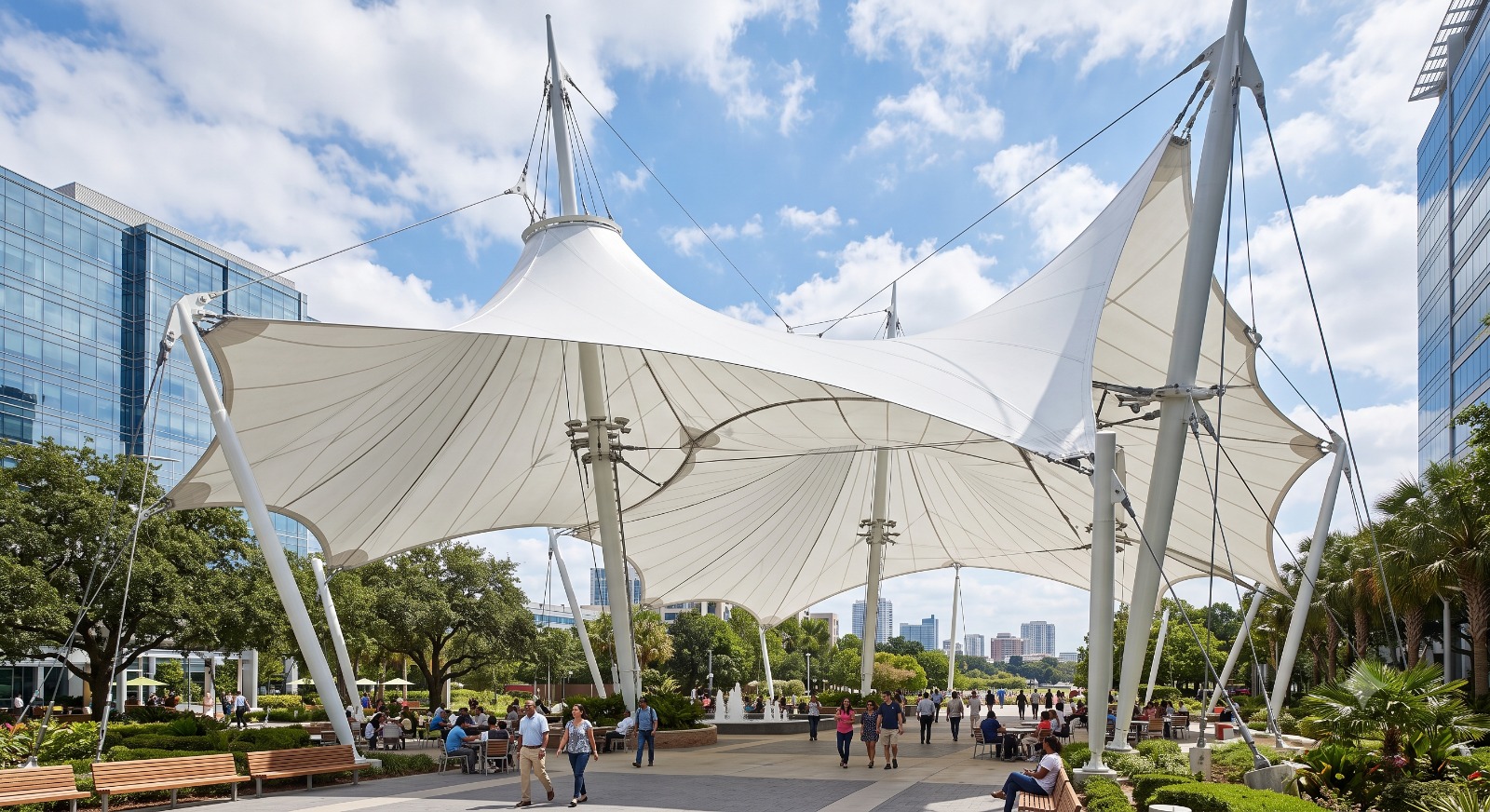
- Mast-supported structures — one or more central masts push the fabric upward from key points, with the membrane pulled down and out to anchor points around the perimeter. This is the classic saddle-shaped canopy look.
- Frame-supported structures — a rigid frame (steel or aluminium) defines the overall shape, and the fabric is tensioned onto or within that frame. Often used for smaller canopies, walkways, and car parking shades.
- Air-supported structures — the fabric membrane is held in shape by internal air pressure rather than mechanical tensioning alone, commonly used for domes covering large enclosed spaces like sports facilities or, in industrial contexts, biogas covers.
Each form suits different spans, budgets, and architectural goals, but all of them rely on the same underlying principle: fabric under continuous, engineered tension.
What Is Tensile Roofing, Specifically?
Tensile roofing is the application of tensile fabric as the primary roof covering of a structure, as opposed to using it for a wall, canopy, or standalone shade. The same tensioning principles apply, but roofing applications carry extra demands.
A roof has to do more than just look good stretched across a frame — it has to shed water effectively, resist ponding at low points, handle wind uplift without fluttering, and hold its shape through seasonal temperature swings, all while staying watertight at every seam and edge for the life of the structure.
This is where the slope and curvature of the design matter as much as the fabric itself. A tensile roof is typically engineered with enough pitch and curvature that water runs off naturally rather than pooling, since standing water adds unplanned load and can stress the membrane at exactly the points it's least able to handle it. Getting this geometry right, alongside the right fabric coating, is what separates a roof that performs for years from one that develops problems early.
What Is Tensile Fabric Made Of?
At its core, tensile fabric is a woven textile — usually a polyester base cloth — coated with a protective polymer layer that gives it strength, waterproofing, and weather resistance. The base fabric provides the tensile strength (the ability to be pulled tight without tearing), while the coating protects it from sun, rain, and general wear, and seals the weave against water penetration.
Different type of fabrics used in tensile structures are:
- PVC (Polyvinyl Chloride) coated fabric — a widely used coating for tensile applications, valued for its flexibility, ease of fabrication, and reliable waterproofing. PVC-coated fabric can be welded into large, complex panel shapes and holds up well across a broad range of climates, which is part of why it remains a standard choice for canopies, shade structures, and mid-to-large span tensile roofing.
- PVDF (Polyvinylidene Fluoride) coated fabric — a fluoropolymer coating engineered for structures that need a particularly resilient, long-lasting outer surface. PVDF-coated fabrics are built to resist UV exposure, pollution, and general environmental wear over extended outdoor use, while still keeping the flexibility needed for tensioned installation.
Both coating types are built on the same core idea — a strong woven base combined with a protective, waterproof polymer layer — engineered specifically for outdoor, long-span tensile use. The right choice for a given project usually comes down to the specific climate, design requirements, and finish the architect or contractor is targeting.
Properties That Matter in Tensile Fabric
Whichever coating a project uses, a genuinely purpose-built tensile fabric needs to deliver on several fronts at once:
- Strength under tension — engineered to handle continuous pulling force without stretching out of shape or losing structural integrity over time
- Weather resistance — built to hold up against sun, rain, humidity, and temperature shifts across different climates
- Flexibility — pliable enough to be shaped into curves and complex geometries during fabrication, without cracking at fold lines or seams
- Waterproofing — a sealed coating that keeps water from penetrating the weave, even at welded joints
- Dimensional stability — the ability to hold its engineered shape under load, rather than creeping or sagging over time
- Colour and finish options — coated fabrics can be produced in a range of finishes, giving architects flexibility to match a building's design intent
This is really what separates purpose-built tensile fabric from a generic tarpaulin: the coating chemistry, the weave quality, and the fabrication precision all have to work together for the membrane to perform once it's under real tension outdoors.
From Fabric to Finished Structure: The Fabrication Process
Getting from a roll of coated fabric to a finished tensile panel involves a fair amount of precision. The fabric is cut according to a pattern derived from the structure's engineered shape — because the surface is doubly curved, panels aren't simple rectangles; they're cut to specific curved profiles that, once welded together and tensioned, produce the intended three-dimensional form.
The panels are then welded along their seams, typically using heat or high-frequency welding methods suited to the coating type, producing joints that are as watertight and durable as the fabric itself. Edge details, cable pockets, and reinforcement patches are added where the membrane will connect to the support structure, since these connection points carry concentrated loads and need extra attention during fabrication.
The precision of this cutting and welding process has a direct impact on how the finished structure performs — a panel cut slightly off from its intended curvature can create uneven tension across the membrane once installed, leading to wrinkles, water pooling, or premature wear at stress points.
Applications: Where Tensile Fabric Is Used
Tensile fabric shows up in a wider range of settings than most people expect. Some of the most common applications include:
- Stadiums and arenas — large-span roofing that covers seating areas without heavy interior columns blocking sightlines
- Airport terminals and transit hubs — canopies and roofing that combine architectural presence with practical weather protection over high-traffic areas
- Shopping mall atriums and walkways — daylight-friendly coverage that shades and shelters pedestrian areas
- Car parking shades — a cost-effective way to protect vehicles from sun and rain across large parking areas
- Open-air event and exhibition spaces — temporary or semi-permanent coverage for markets, exhibitions, and outdoor venues
- Industrial and warehouse canopies — practical, quick-to-install coverage for storage, loading, and work areas
- Awnings and building facades — smaller-scale tensile applications that add shade and architectural detail to individual buildings
Across all of these, the appeal is largely the same: a lot of covered area, a lightweight structure, and a distinctive architectural form that's hard to achieve with conventional building materials.
Tensile Fabric vs Conventional Roofing Materials
It's worth understanding why architects and builders reach for tensile fabric over conventional roofing in the first place. Traditional roofing — metal sheeting, concrete, or tiled systems — relies on rigid materials that carry their own weight through compression and support beams. That works well for many buildings, but it comes with real limits on span, weight, and shape.
Tensile fabric structures, by contrast, can cover very large open areas with comparatively little material, since the membrane is doing the work through tension rather than mass. That generally means lighter foundations, faster installation timelines, and design flexibility that rigid materials simply can't match — curved, conical, and saddle-shaped forms that would be difficult or prohibitively expensive to build conventionally. Daylight transmission is another factor: many tensile fabrics allow a degree of natural light through, reducing the need for artificial lighting during the day in covered spaces.
None of this makes tensile fabric a universal replacement for conventional roofing — it's simply a different toolkit, best suited to large spans, distinctive architectural forms, and applications where weight and speed of construction matter.
Choosing a Tensile Fabric Manufacturer
Because the fabric is the single most important component in a tensile structure, the manufacturer behind it matters. A good tensile fabric manufacturer in India should be able to show you the base textile quality, explain the coating process, and fabricate the panels — cutting, welding, and finishing — to the exact specifications your project calls for.
A few things worth checking when evaluating a fabrics manufacturer and supplier for a tensile project:
- Coating expertise — a clear understanding of how PVC and PVDF coatings behave, and which suits your project's climate and design
- Fabrication capability — the ability to cut and weld panels precisely to the curved geometry your structure needs
- Consistency — reliable quality across large orders, since a tensile roof is only as strong as its weakest seam
- Range of finishes — colour and finish options that let architects match the fabric to the building's design intent
- Project support — a team that can work with your design and engineering requirements rather than offering a one-size-fits-all product
LUCKY-TECH Membranes works with PVC and PVDF coated fabric for tensile applications, awnings, canopies, and a range of other outdoor structural uses. As a fabrics manufacturer and supplier, the focus stays on getting the material right — durable coatings, consistent weld quality, and fabric that's genuinely ready for the demands of an outdoor tensile installation.
If you're sourcing fabric for an upcoming tensile project, you can see the current product range at LUCKY-TECH Membranes.
Maintaining a Tensile Fabric Structure
One of the practical advantages of tensile fabric is that it doesn't demand heavy ongoing maintenance. Routine cleaning — usually just water and a mild detergent — keeps the coated surface free of dirt buildup, which helps preserve both its appearance and its weather resistance over time. Periodic visual checks of the tensioning cables, anchor points, and seams are a good habit, catching small issues like a loosened cable or a stressed weld before they become bigger problems.
Because the coated surface is designed to resist UV and general environmental wear, tensile fabric generally holds its condition well with this kind of light, regular attention rather than intensive upkeep.
Frequently Asked Questions
Is tensile fabric only used for roofing?
No. While tensile roofing is one of the most visible applications, the same fabric is used for wall cladding, canopies, shade structures, and free-standing architectural forms.
What's the difference between PVC and PVDF coated fabric?
Both are polyester-based fabrics with a protective polymer coating, engineered for outdoor tensile use. PVC coatings are flexible and well suited to a broad range of tensile applications, while PVDF coatings are formulated for added resilience against UV and environmental exposure. The right choice depends on the specific project and climate.
Can tensile fabric be custom coloured?
Yes. Coated fabrics can generally be produced in different colours and finishes, so the material can be matched to a building's design intent.
Does tensile fabric need much maintenance?
Routine cleaning and periodic inspection of the tensioning system is usually enough. The coating itself is designed to resist dirt buildup and weathering.
Why is the fabric shaped in curves instead of flat panels?
The double-curved (anticlastic) shape is what keeps the membrane stable under tension. Curving in two directions at once helps the fabric resist wind and rain loads without fluttering or ponding water, which a flat surface couldn't do as effectively.
Is tensile fabric suitable for large-span structures like stadiums?
Yes — large spans are actually one of the areas where tensile fabric performs best, since it can cover wide open areas with comparatively little material and few, if any, interior columns.
Get Your Free Quote Today!