
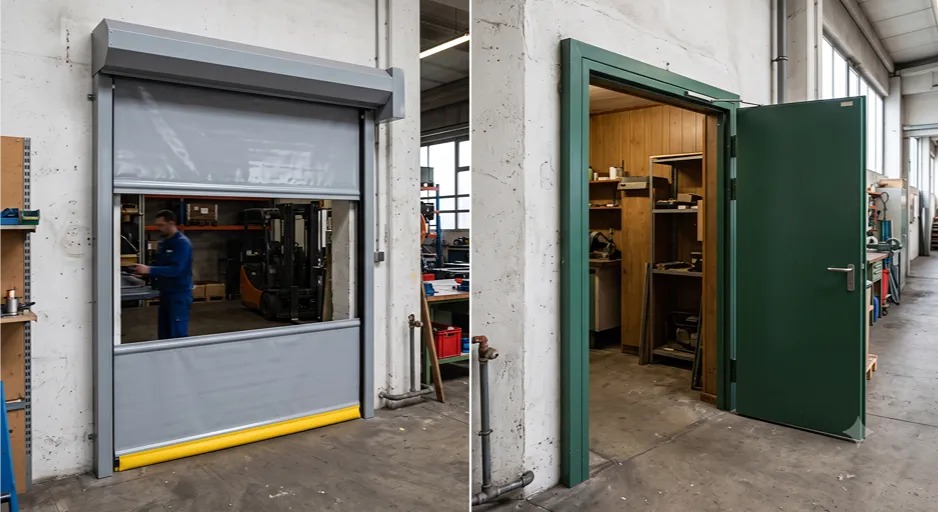
Roll-Up Doors vs Hinged Doors: Which is Right for Your Space?
Roll-Up Doors vs Hinged Doors: Which is Right for Your Space?
Choosing the right door for a warehouse, factory, or loading bay is not always simple. Two common options are roll-up doors and hinged doors. They look different and work differently, and one usually fits your space much better than the other. This guide covers the difference between a roll-up door and a hinged door, with a closer look at roll-up doors and the coated fabric used to make them.
Get In TouchWhat is a Roll-Up Door?
A roll-up door opens by rolling upward, usually into a coil above the opening, instead of swinging out like a regular door. This makes it a strong choice for spaces where floor and wall clearance is limited.
Roll-up doors are widely used in warehouses, factories, loading docks, cold storage units, and industrial facilities of all kinds. Many roll-up doors use coated fabric instead of solid metal panels, which makes them lighter to operate, quicker to open and close, and easier to maintain day to day. Because they move straight up, they don't need extra floor space, so equipment, vehicles, and people can move freely around the opening.
Roll-up doors are also built for frequent use. In busy facilities where a door opens and closes many times a day, this matters a lot. A well-made roll-up door keeps operations moving without slowing things down.
What is a Hinged Door?
A hinged door is the traditional type most people know. It's attached to a frame with hinges and swings open on one side. Hinged doors are common in offices, small rooms, and low-traffic entry points.
They are simple to install, but they need open floor space to swing, which can get in the way in a busy work area or where machinery and vehicles are moving around.
Roll-Up Door vs Hinged Door: Key Differences
Space usage Roll-up doors move vertically, so they don't take up floor space when open. Hinged doors need a clear swing radius, which isn't always practical in an industrial setting.
Durability Roll-up doors, especially those made with coated fabric, are built to handle daily wear from vehicles, forklifts, and heavy equipment. Hinged doors suit lighter, less frequent use.
Speed of operation Roll-up doors open and close quickly, keeping work moving in busy facilities. Hinged doors are generally slower to operate.
Best fit Hinged doors work well for offices and low-traffic entry points. Roll-up doors are built for warehouses, industrial units, and loading bays, where quick access and space-saving really matter.
Roll-Up Door Fabric: PVC and PVDF Coated Options
The fabric used in a roll-up door plays a big role in how well it performs. Two of the most widely used options are PVC coated fabric and PVDF coated fabric.
PVC coated fabric is flexible, weather-resistant, and holds up well under regular industrial use. It's a practical choice for roll-up doors that see frequent daily movement, offering good strength without adding unnecessary weight to the door.
PVDF coated fabric adds an extra protective top layer to the base coating. This helps the fabric handle outdoor exposure and keeps its surface looking clean for longer, which is useful for roll-up doors installed in areas exposed to sun, dust, or changing weather.
Both fabric types are used across industrial roll-up doors depending on the facility's needs and location. Working with experienced PVC Roll Up Door fabric Manufacturers makes a real difference here, since the quality of the coated fabric directly affects how smoothly the door operates and how long it lasts.
At LUCKY-TECH Membranes, we work as Fabrics Manufacturers and Supplier, providing PVC and PVDF coated fabric built for roll-up doors and other industrial applications that need a material tough enough for daily use.
Why Choose LUCKY-TECH Membranes
LUCKY-TECH Membranes works with coated textiles engineered by SIOEN Industries, a name trusted worldwide for technical fabrics, and shapes them in-house to fit each customer's roll-up door requirements.
We supply coated fabric for a wide range of industrial applications, including roll-up doors, truck covers, and tensile structures, so we understand what a fabric needs to hold up to daily industrial use. As fabric manufacturers and suppliers, our focus stays on giving customers a coated fabric they can rely on for the long run.
Which One is Right for Your Space?
If you're working with limited floor space, need quick access, or run a facility with heavy daily traffic, a roll-up door is usually the better fit. For smaller rooms or low-traffic entry points, a hinged door can work fine and is often simpler to install.
For warehouses, factories, and loading areas, the coated fabric used in the roll-up door plays a big role in how well it performs over time. Choosing the right fabric supplier is just as important as choosing the door type itself.
FAQs
What is a roll-up door used for?
Roll-up doors are mainly used in warehouses, factories, and loading bays where quick access and space-saving matter.
Is a roll-up door better than a hinged door?
It depends on the space. Roll-up doors work better for busy, space-limited areas, while hinged doors suit smaller, low-traffic spaces.
What fabric is used in industrial roll-up doors?
Most industrial roll-up doors use PVC or PVDF coated fabric, chosen for flexibility, weather resistance, and the ability to handle daily wear.
Do roll-up doors need more maintenance than hinged doors?
Not necessarily. Coated fabric roll-up doors are designed to handle regular use with simple upkeep.
Get Your Free Quote Today!