
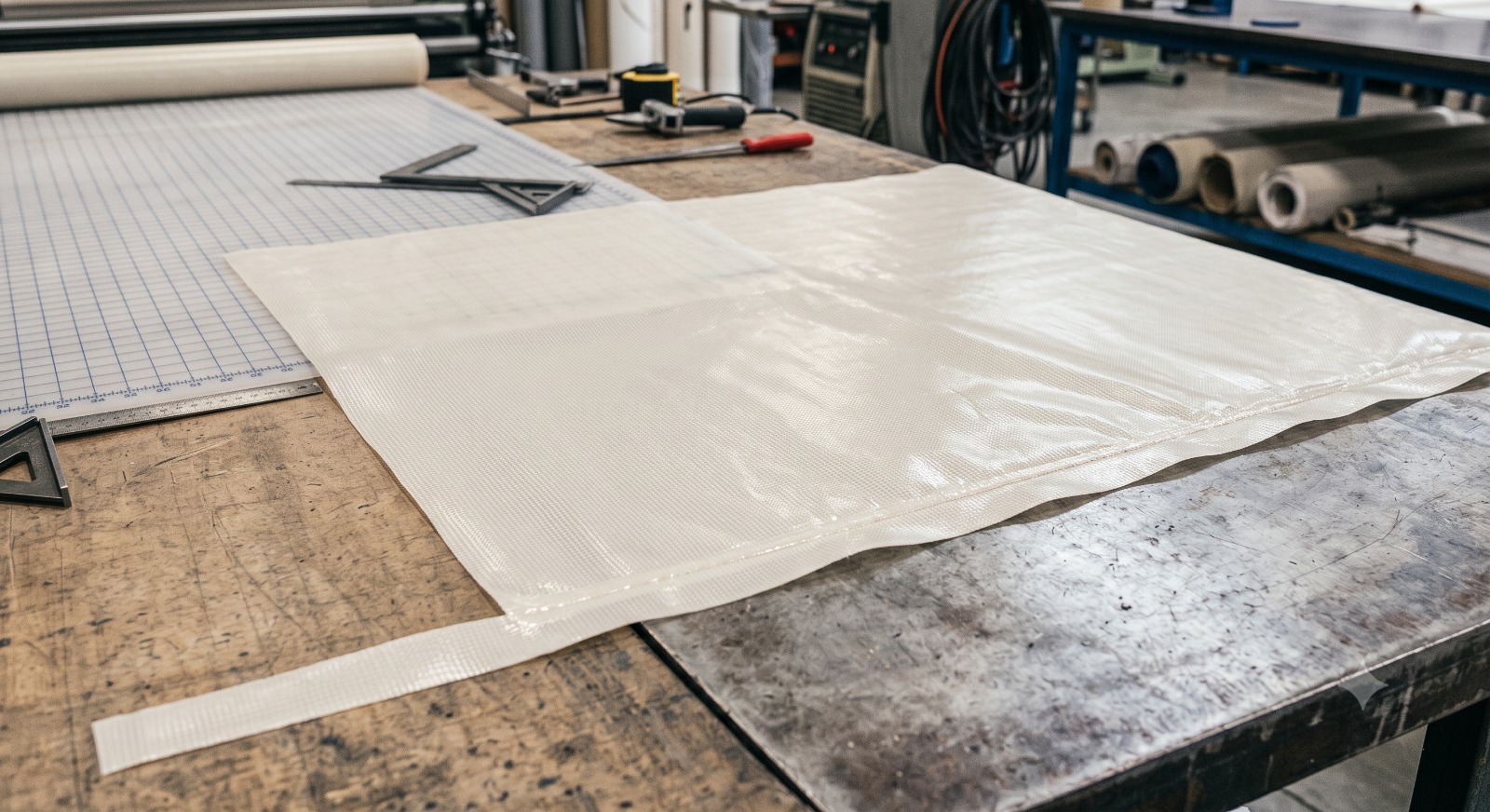
How Membrane Fabric Is Actually Cut and Welded
How Membrane Fabric Is Actually Cut and Welded
PVC Fabric Cutting and Welding: How High Frequency Welding Builds Membrane Structures
A membrane structure is only as strong as its seams. Here's how high frequency welding turns flat fabric into finished structures.
Anyone who has stood under a Tensile Membrane Structure or walked past a biogas dome has probably never thought about how that single curved surface came from flat rolls of fabric. It did not arrive in that shape. It was cut, panelled, and welded piece by piece until the seams disappeared into a smooth, load bearing skin. Get the cutting wrong and the panels never line up. Get the welding wrong and the structure fails at the seam long before the fabric itself gives way.
Leading Fabrics Manufacturers and Supplier in India treat this stage as the real engineering work behind every membrane project, not just a production step that happens after the design is finalised.
Get In TouchWhy Cutting Comes Before Welding
A membrane structure starts as a 3D design that has to be flattened into 2D panels, a process called patterning. Every dome, canopy, or tensile roof is made of many individual fabric panels, each shaped slightly differently so that when they are joined, they recreate the intended curve.
This is where cutting accuracy matters most. If a panel is cut even slightly off from its pattern, the error does not stay small. It compounds across every seam it touches, and by the time the structure is assembled, the surface can pucker, sag, or pull unevenly at the anchor points. That is why panel cutting for architectural and industrial fabric is not done freehand. It is guided by pattern data generated from the structural design, so every panel is cut to the exact shape the engineering calls for.
What High Frequency Welding Actually Does
Fabric panels are not sewn together the way canvas or tarpaulin might be for lighter applications. PVC and PVDF coated fabrics are welded, and the most common method for architectural and industrial membranes is high frequency welding, sometimes called radio frequency or dielectric welding. This entire cutting and joining sequence is the PVC fabric cutting and welding process that turns flat rolls into finished panels.
Here is the basic idea. High frequency energy is passed through the overlapping edges of two fabric panels. This energy excites the polymer molecules in the PVC coating, generating heat from within the material itself rather than from an external heating element touching the surface. As the coating softens, pressure from the welding jaws fuses the two layers into one continuous sheet. Once it cools, the seam is not a joint anymore. It behaves as a single piece of material.
This is fundamentally different from stitching. A stitched seam relies on thread, and thread punctures the fabric, creating entry points for water and stress. A welded seam has no punctures. The bond runs along the entire overlap, which is why welded seams are typically the stronger and more weatherproof option for tensioned outdoor structures.
Why Consistency Matters More Than Speed
A weld is only as good as its consistency along the entire seam length. Uneven pressure, inconsistent energy delivery, or variation in overlap width can all create weak points, and a weak point in a tensioned membrane is exactly where a tear starts under load or wind stress.
This is why fabrication quality depends heavily on how controlled this membrane fabrication technology is. Panels need to be cut to match their pattern precisely so the overlap at every seam is consistent. The welding itself needs steady, repeatable control over pressure and energy so that a seam welded at the start of a panel run performs the same way as one welded at the end. Skilled operators and well maintained equipment matter here as much as the machine itself, since welding parameters often need to be adjusted for fabric weight, coating type, and ambient conditions.
PVC Versus PVDF at the Weld
PVC & PVDF Coated Fabrics are not identical at the seam. PVDF is typically used as a top coat layer for its resistance to UV degradation, dirt pickup, and weathering, while the base fabric underneath is usually still PVC coated polyester. Because the weld itself fuses the PVC layers beneath the surface coating, welding parameters have to account for the full layer structure of the fabric, not just the outer finish. Getting this wrong can leave a weld that looks fine on the surface but is not properly fused underneath, which only shows up later as seam failure.
From Panel to Finished Structure
Once panels are cut and welded into their final shape, keder edges, webbing, and reinforcement details are added along the perimeter so the membrane can be tensioned and anchored to its structural frame. At that point, the fabric stops being a flat material and becomes a structural component, expected to carry tension loads, resist wind and rain, and hold its shape for years.
None of that is possible without the cutting and welding stage getting the geometry and fabric seam strength right the first time. It is a step that rarely gets attention from anyone outside the industry, but it is the part of tensile fabric fabrication that decides whether the finished structure performs the way it was designed to.
Lucky-Tech Membranes fabricates PVC and PVDF coated fabric structures using this pattern based cutting and high frequency welding process, working from design and engineering data through to finished, weld tested panels.
Frequently Asked Questions
What is high frequency welding in fabric fabrication?
It is a method of joining high frequency welding fabric panels by using high frequency energy to heat the coating from within, fusing the overlapping layers into one continuous, puncture free seam.
Is welded fabric stronger than stitched fabric?
For architectural and industrial membranes, welded seams are generally preferred because they avoid needle holes and distribute stress more evenly along the seam, which improves weather resistance and seam strength.
Why does panel cutting accuracy matter for membrane structures?
Membrane structures are built from flat panels that recreate a curved surface once joined. Even small cutting errors compound across seams and can distort the final shape of the structure.
Can PVDF coated fabric be welded the same way as PVC fabric?
Yes, since the base fabric is still PVC coated. The welding process has to account for the full layer structure, including the PVDF top coat, to get a properly fused seam.
Does the type of fabric affect welding settings?
Yes. Fabric weight, coating composition, and ambient conditions can all influence how welding pressure and energy need to be adjusted for a consistent seam.
Get Your Free Quote Today!