
Latest Trends in Coated Fabric Technology for Air Dome Fabric
Latest Trends in Coated Fabric Technology for Air Dome Fabric
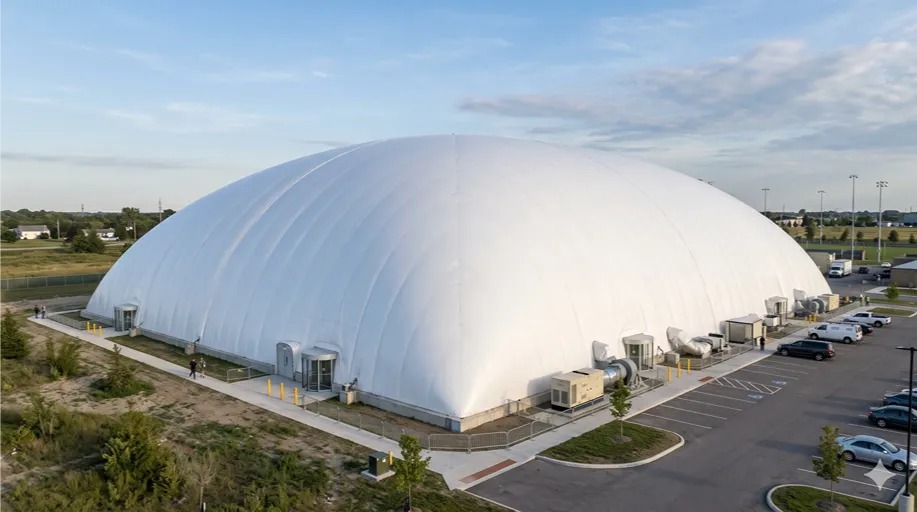
An air dome stands because of one thing: its fabric. There is no heavy roof or thick wall. The whole shell is a thin membrane held up by air. So the fabric has to be strong, light, weather-proof and gas-tight all at once.
Coated fabric technology keeps moving forward. Better coatings, smarter finishes and cleaner production methods are changing what an air dome fabric can do. If you plan to buy or specify an air dome in India, it helps to know where the technology is heading. In this blog, we look at the latest trends in simple words.
Get In TouchWhy the Fabric Matters So Much
An air dome is held in shape by a small amount of air pressure inside. That means the fabric takes the load all day, in sun, wind and rain. If the fabric is weak, the dome is weak.
PVC coated fabric is a popular choice for air domes. It has a strong woven base and a protective coating on both sides. The base gives strength. The coating gives waterproofing, air-tightness and weather protection.
Because the fabric does so much work, a good PVC Fabrics Manufacturer & Suppliers partner can make a big difference to how your dome performs.
Trend 1: Stronger Base Fabrics
The base fabric is the skeleton of the material. It is a woven mesh of high-strength polyester yarn.
The trend here is towards tighter, more even weaves. A balanced weave spreads the load well across the fabric. This helps the fabric hold its shape and resist tearing. It also helps the dome keep a smooth, tight surface.
Stronger base fabric also means the dome can be made lighter and more efficient without losing safety.
Trend 2: Better Coating Formulas
The coating is where much of the progress happens. Modern PVC coatings are made to bond well with the base fabric. A good bond stops the coating from peeling or cracking with use.
Coatings are also being made more flexible. This matters for air domes because the fabric moves with the wind and with changes in air pressure. A coating that stays flexible handles this movement better and is less likely to crack at folds.
Another focus is even coating thickness. An even coat gives the same protection across the whole dome.
Trend 3: Protective Top Coats
Air domes live outdoors. The surface faces sunlight, dust and rain day after day.
Top coats are applied over the main coating to protect it. PVDF top coating is one popular choice. It helps the surface resist dirt, stains and sunlight. A cleaner surface also looks better for longer.
This trend is especially useful for large domes, where cleaning is not easy. A fabric that stays cleaner needs less effort to maintain.
Trend 4: UV and Weather Resistance
Sunlight is tough on any outdoor material. Over time, UV rays can fade colour and weaken coatings.
Modern coated fabrics use stabilisers that guard against UV damage. They also help the fabric handle heat, rain and humidity. This is important in India, where the climate can swing from strong sun to heavy monsoon.
Better weather resistance means the fabric keeps its look and its performance as the seasons change.
Trend 5: Fire Safety and Special Finishes
Safety is a growing concern for any large covered space. Air domes are often used for sports, storage and events, where many people may gather.
Flame-retardant grades of coated fabric are now widely asked for. These are made so that the fabric resists catching and spreading fire. Always check that the fabric meets the fire rules that apply to your project.
Other finishes are also gaining attention. Anti-fungal treatments help the fabric resist mould in damp conditions. Easy-clean surfaces make upkeep simpler.
Trend 6: Light and Colour Options
Many buyers want a bright, pleasant space inside the dome. Coated fabrics now come in a range of colours and levels of light transmission.
A light-coloured fabric lets daylight in and helps the inside feel open. It can also reflect part of the sun's heat. Colour is not only about looks. It affects comfort and how much artificial light you need during the day.
Colours are also being made more stable, so that they stay even and do not fade unevenly.
Trend 7: Welded Seams Over Stitching
An air dome is made from many panels joined together. The joins, or seams, must hold the air in.
The move towards high-frequency welding has made a real difference. In this method, the coated panels are fused together using heat and pressure. The result is a strong, sealed seam without needle holes. This helps the dome stay air-tight and keeps the fabric strong along the joins.
Good welding needs good machines and trained hands. It is one of the most important steps in making air dome fabric panels.
Trend 8: Digital Cutting and Better Accuracy
An air dome is made from carefully shaped panels. If the panels are cut even slightly off, the dome may not sit right.
Digital cutting machines now cut fabric panels with high accuracy based on the design file. This reduces waste and keeps each panel true to the plan. When every panel fits properly, the finished dome has a clean shape and a tight surface.
Trend 9: A Growing Focus on Responsible Production
Buyers are paying more attention to how materials are made. There is growing interest in cleaner production, less waste and better use of raw materials.
In fabric making, this shows up in tighter process control, careful cutting to reduce offcuts, and attention to quality at each step. Fabric that is made well and lasts well is also a more responsible choice, since it does not need to be replaced as often.
Trend 10: Tighter Quality Checks
Last, quality testing is becoming more important. Buyers want to know that the fabric has been checked for strength, coating bond and seam quality.
A maker that checks its fabric at each stage gives you more confidence in the final dome. When you speak to a supplier, ask how the fabric and seams are tested.
What This Means for Air Dome Buyers in India
If you are looking at Air Dome India options, here is a simple way to use these trends.
Start with the use of the dome. A sports dome, a storage dome and an event dome may ask for different things from the fabric. Then think about the weather at your site, fire safety needs and how much light you want inside.
Next, look at the fabric and the welding. These two things decide how your dome will behave. Look for a maker who can explain the fabric in plain words and is open about how the panels are cut and joined.
Finally, choose a partner who can help you from fabric selection to finished panels. Working with a trusted Air Dome Manufacturer who understands coated fabric makes the whole process smoother.
Why Choose LUCKY-TECH Membranes
At LUCKY-TECH Membranes, our focus is on PVC and PVDF coated fabric. Our coated textiles are engineered by SIOEN Industries of Belgium, and we design, cut and weld them in-house to match your requirement.
Our facility is equipped with European machinery, including Zünd cutting machines and Forsstrom high-frequency welding machines. This helps us keep panels accurate and seams strong. A team of 300+ professionals works across design, engineering, cutting, welding and finishing, and we collaborate with international technology partners to keep improving.
If you are searching for a PVC Fabrics Manufacturer & Suppliers partner for air dome fabric, or an Air Dome Manufacturer who puts the fabric first, talk to LUCKY-TECH Membranes. We will help you choose the right fabric for your air dome in India.
Get Your Free Quote Today!