
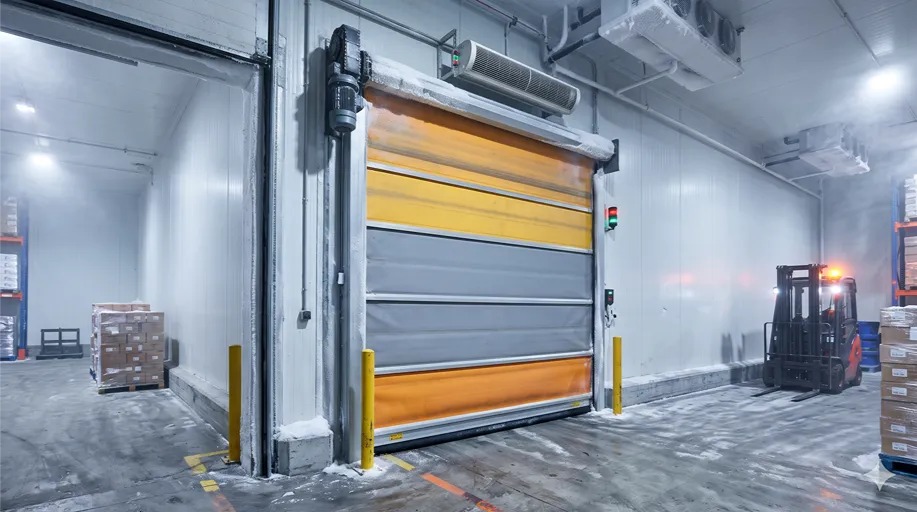
How to Choose the Right Fabric for Cold Storage Roll-Up Doors
How to Choose the Right Fabric for Cold Storage Roll-Up Doors
Cold storage doors work harder than most doors in a building. They open and close all day, and they face cold air on one side and warm, moist air on the other. The door fabric has to handle all of this without cracking, sagging, or letting cold air leak out. So the fabric you pick matters a lot.
This guide explains what to look for when choosing fabric for cold storage roll-up doors, in plain words.
Get In TouchWhy Cold Storage Doors Need Special Fabric
A cold room is a sealed space. Every time a door stays open, cold air escapes and warm air comes in. That makes the cooling system work harder and puts the stored goods at risk.
Roll-up doors help because they open and close fast, so the opening stays small and short-lived. But speed alone is not enough. The fabric must stay flexible in the cold, hold its shape, and keep working after thousands of cycles. A weak fabric becomes stiff, cracks at the folds, or wears out at the edges.
That is why cold storage needs a fabric made for the job, not a general-purpose sheet.
Why PVC Coated Fabric Is a Strong Choice
Most high-speed roll-up doors use PVC coated fabric, and there are good reasons for it.
PVC coated fabric has a strong woven base with a PVC coating on both sides. The base gives strength. The coating gives protection. Together they make a fabric that is tough, easy to clean, and able to take repeated rolling and unrolling.
For cold storage, the main benefits are:
- It resists moisture, so water and condensation do not soak in.
- It can be cleaned easily, which matters in food and pharma areas.
- It handles daily movement without tearing easily.
- It can be welded into clean, strong seams.
PVDF coated fabric is another option. The PVDF top layer adds extra surface protection and helps keep the fabric looking clean. It suits places where the door sees a lot of washing or harsh surroundings.
Key Things to Check Before You Choose
1. Flexibility in Cold Conditions
This is the most important point. A door that is flexible at room temperature may turn stiff in a freezer. Stiff fabric cracks where it bends. Ask for a fabric that is made to stay supple in cold working conditions, and confirm it for the temperature range of your room.
2. Strength of the Base Fabric
A roll-up door moves again and again. The base textile carries that load. A strong base fabric keeps the door from stretching, sagging, or tearing at the edges. Good fabric also helps the door close in a straight, even line, which gives a better seal.
3. Quality of the Coating
The coating protects the base from water, dirt, and wear. A well-made coating is smooth and even, and it bonds firmly to the textile. Poor coating can peel, bubble, or crack over time. Look for fabric from a source that controls coating quality closely.
4. Weldability
Roll-up doors are made by cutting fabric panels and joining them. Many door makers use high-frequency welding for this. Good PVC fabric welds cleanly, so seams stay strong and tidy. If the fabric does not weld well, seams become the weak point of the door. Always ask whether the fabric is suited to welding.
5. Vision Panels and Colour Options
Many cold storage doors have a clear window so forklift drivers can see people and traffic on the other side. This is a safety feature. Check that the fabric supplier can offer matching clear panels along with the solid fabric. Colour choice also helps, since many sites use colours to mark zones or to match their branding.
6. Surface Finish
A smooth surface is easier to wipe and wash. In cold rooms, frost and moisture can build up, so a surface that cleans easily saves effort. For food-related areas, a clean and hygienic surface is a big plus.
7. Consistency from Batch to Batch
If you need many doors, or you will need replacement panels later, the fabric should stay the same from one order to the next. Consistent quality means doors that look and behave alike. This is one more reason to deal with a steady, reliable source.
Match the Fabric to the Door Use
Not every cold storage door is the same. Think about where the door will be used.
Freezer or chiller entry: The door faces the biggest temperature gap, so cold flexibility and a good seal are most important.
Loading dock side: The door may face dust, wind, and rough handling. Tear strength and surface protection matter more here.
Internal zone doors: These separate one temperature zone from another. Fast operation and clear vision panels are useful.
Washdown areas: Choose a fabric with a smooth surface that is easy to clean, such as a PVDF coated option.
Why Source Matters: Working with a Roll-Up Doors Fabric Manufacturer & Supplier
The fabric is the heart of a roll-up door. The frame and motor can be perfect, but if the fabric fails, the door fails. That is why the choice of a roll-up doors fabric manufacturer and supplier deserves real attention.
Look for a partner who understands both the material and the way doors are built. They should help you pick the right fabric, cut it to size, and finish it well. A partner with proper cutting and welding facilities can also deliver panels that are ready to use, which saves time for door makers.
Why Choose LUCKY-TECH Membranes
LUCKY-TECH Membranes is a PVC fabric manufacturer and supplier in India, working with engineered PVC and PVDF coated fabric. The company partners with SIOEN Industries of Belgium, whose coated textiles form the base of its products.
LUCKY-TECH Membranes handles design, cutting, welding, and finishing in-house. The work is done on European-grade machines, including Zünd cutting systems and Forsstrom high-frequency welding machines. This helps produce clean cuts and strong, neat seams, which is exactly what a roll-up door panel needs.
A team of more than 300 professionals supports the work, from fabric selection to finished membrane panels. Because the company works with international technology partners, it brings global know-how to local needs.
For door makers, dealers, and cold storage owners, this means one dependable source for engineered PVC and PVDF fabric, cut and welded to your requirement. You can talk to the team about your door size, your working conditions, and your cleaning needs, and get guidance on the right fabric for the job.
Get Your Free Quote Today!