
What is a Car Canopy? Types, Uses and Fabric Options
What is a Car Canopy? Types, Uses and Fabric Options
What Is a Car Canopy? Types, Uses and Choosing the Right Fabric
If you park your car outdoors, you already know what sun, rain, and dust can do to it over time. A car canopy is one of the simplest ways to protect a vehicle without building a full garage. In this post, we will look at what a car canopy actually is, the common types you will come across, where they are used, and why the fabric you choose matters more than most people think.
Get In TouchWhat is a Car Canopy?
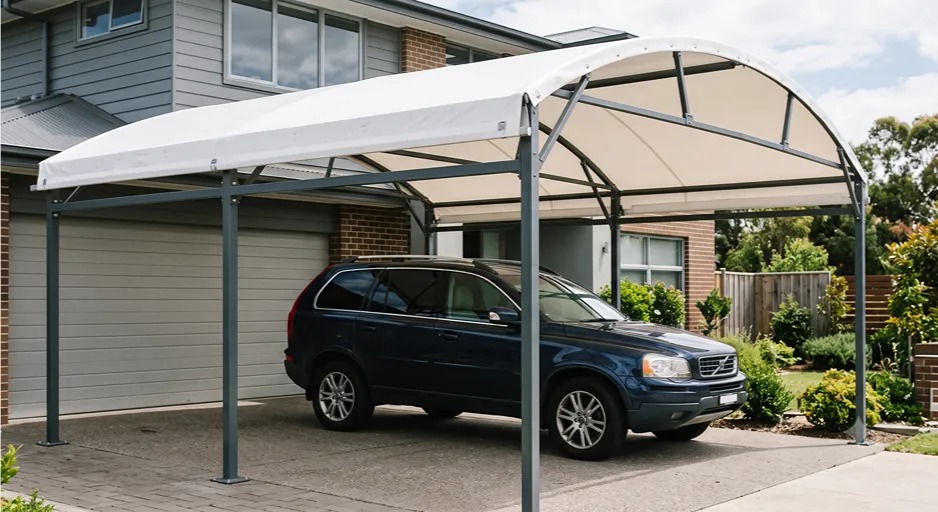
A car canopy is a shade structure built over a parking spot. It usually has a sturdy frame, made from steel or aluminium, covered with a tensioned fabric membrane on top. The fabric acts as the roof. It blocks direct sunlight, keeps rain off the car, and reduces heat buildup inside the vehicle.
Unlike a closed garage, a car canopy is open on the sides. This keeps air moving underneath and makes the structure lighter and quicker to install. That is why canopies are so common at homes, offices, malls, and large parking facilities.
Common Types of Car Canopies
Car canopies come in a few different shapes and setups, depending on the space and the number of vehicles that need cover.
- Cantilever canopies – supported from one side only, with no pillars blocking the parking bay. Good for tight spaces.
- Standard post-supported canopies – pillars on both sides hold up the frame. Simple, strong, and cost-effective for large lots.
- Tensile car parking shades – the fabric is stretched tightly across a curved or angled frame, giving a smooth, modern look along with good shade coverage.
- Cluster or row canopies – one long structure covering multiple parking bays in a line, often seen in office and commercial parking areas.
The right type usually depends on how many vehicles you need to cover, the shape of the parking area, and how much headroom is needed for larger vehicles.
Where Car Canopies Are Used
Car canopies are not just for homes. You will find them in a wide range of places:
- Residential driveways and housing societies
- Corporate and office parking lots
- Shopping malls and retail parking areas
- Schools, colleges, and hospitals
- Fuel stations and public parking facilities
In every case, the goal is the same: protect vehicles from harsh sun and rain, keep the parking area cooler, and add a neat, organised look to the space.
Why Fabric Choice Matters for Car Parking Shade
The frame gives a canopy its shape, but the fabric is what does most of the protective work. A good car parking shade fabric needs to handle constant sun exposure, sudden rain, dust, and temperature changes, day after day, without losing its strength or shape.
A weak or poor-quality fabric can sag, discolour, or develop small tears sooner than expected, which means the canopy stops doing its job properly. This is why choosing the right fabric type is just as important as choosing the right frame design.
PVC Coated Fabric for Car Canopy
PVC coated fabric is one of the most trusted materials used for car canopies today. It is made by coating a strong base textile with PVC (or PVDF for extra surface protection), which gives the fabric its weather resistance and durability.
Some of the reasons PVC coated fabric works so well for car canopies:
- Weather resistance – handles sun, rain, and dust without breaking down quickly
- Flexibility – can be shaped and tensioned to fit different canopy designs, including curved and tensile structures
- Easy maintenance – the smooth surface is simple to clean and does not hold on to dirt
- Good UV protection – helps block harmful sun rays, keeping the parked vehicle and the fabric itself protected
- Wide colour options – the coating allows for a range of colours, so the canopy can match the surrounding architecture
Because of these properties, PVC and PVDF coated fabrics are widely used not just for car canopies, but for awnings and other outdoor shade structures as well.
Choosing the Right Car Canopy Fabric Manufacturer
Once you decide on a car canopy, the next step is finding a reliable fabric partner. A good car canopy manufacturer should be able to guide you on the right fabric weight, coating type, and finish for your climate and usage, rather than offering a one-size-fits-all sheet.
This is where LUCKY-TECH Membranes comes in. As Fabrics Manufacturers and Supplier, LUCKY-TECH Membranes works with PVC and PVDF coated fabrics used across awnings, canopies, and car parking shade structures. Their coated textiles are engineered in partnership with SIOEN Industries, Belgium, and shaped locally to match the exact specifications of each project.
If you are searching for a dependable Car Canopy Fabric Supplier, or looking for Awning, Canopies & Car Parking Shade fabric Manufacturers who understand both the material and its application, it helps to work with a supplier who focuses on the fabric itself, its strength, its finish, and its long-term performance under outdoor conditions.
Frequently Asked Questions
1. What is a car canopy used for?
A car canopy is used to shield parked vehicles from sun, rain, and dust, keeping the car cooler and better protected without building a full garage.
2. Is PVC coated fabric good for outdoor car shades?
Yes. PVC coated fabric is weather-resistant, flexible, and easy to maintain, which makes it a popular choice for car canopies and parking shades.
3. Can a car canopy cover more than one vehicle?
Yes. Cluster or row canopies are designed to cover multiple parking bays under one continuous shade structure.
4. What should I look for in a car canopy fabric?
Look for good UV resistance, flexibility for tensioning, easy cleaning, and a coating type (PVC or PVDF) suited to your local weather.
Get Your Free Quote Today!