
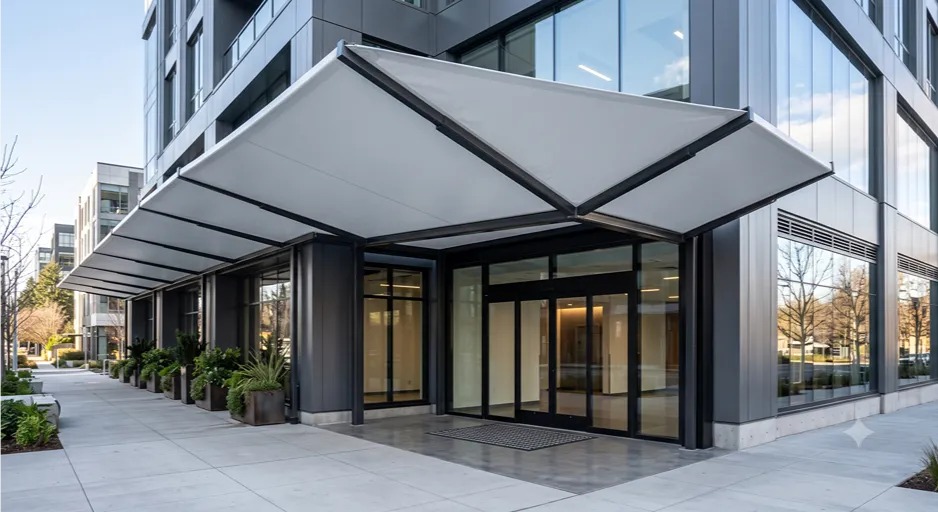
Fabric Considerations for Awning and Canopy Manufacturers
Fabric Considerations for Awning and Canopy Manufacturers
Choosing PVC Coated Fabric for Awning and Canopy Manufacturing
An awning or canopy spends its entire working life outdoors, stretched tight and exposed to sun, rain, and wind without a break. The fabric behind it is what decides whether that structure stays crisp and functional for years or starts sagging, fading, and leaking within a season. For manufacturers, choosing the right PVC coated fabric for awnings and canopies isn't a minor spec decision — it shapes the durability and finish of the entire product.
Get In TouchWhy Fabric Choice Drives the Final Product
Awnings and canopies are judged on how they look and perform outdoors, not just on the frame underneath them. A fabric that stretches unevenly, discolours quickly, or lets water through undermines the whole structure, no matter how well it's engineered mechanically. That's why manufacturers building awnings, canopies, and car parking shades tend to standardise around coated fabric rather than uncoated or lightly treated textiles.
Key Properties to Look For
When evaluating fabric for awning and canopy production, a few properties matter more than any spec sheet number:
- Waterproofing – the coating needs to seal the weave completely, so the canopy sheds rain rather than absorbing it.
- UV and colour stability – constant sun exposure shouldn't cause the fabric to fade or weaken over time.
- Tear and tension strength – awning fabric is stretched taut across a frame, so it needs to hold that tension without stretching out of shape.
- Flexibility for fabrication – the fabric has to be easy to cut, weld, and shape into curves, valances, and panel joins without compromising the seal.
- Consistent finish across panels – for larger canopies made of multiple welded panels, colour and texture need to match seamlessly across the whole structure.
PVC coated fabric checks these boxes reliably, which is why it remains the standard base material across the awning and canopy segment.
How the Fabric Comes Together as a Finished Canopy
Fabric on its own doesn't make an awning — fabrication is what turns raw coated textile into a finished, weatherproof panel. Individual widths are welded using high-frequency or hot-air welding to form larger seamless sections, then cut and finished to the exact shape each structure calls for. At LUCKY-TECH Membranes, this fabrication uses PVC coated textiles engineered by SIOEN Industries, Belgium, cut and welded in-house to each project's specific dimensions. That combination of a dependable coated fabric base and precise fabrication is what gives awnings and canopies their long outdoor service life.
What to Look for in an Awning Fabric Supplier
Manufacturers sourcing fabric for awning and canopy production should check a few things before committing to a supplier. As Fabrics Manufacturers and Supplier, LUCKY-TECH Membranes works with builders looking for dependable Awning, Canopies & Car Parking Shade fabric Manufacturers, and the same checklist applies to any supplier under consideration:
- Confirm the coating type and finish match the intended application, whether that's a retail awning, residential canopy, or car parking shade.
- Ask how panels are welded and joined, since seam quality affects both appearance and weatherproofing.
- Check whether the supplier can fabricate to custom panel sizes and shapes rather than only standard widths.
- Look for reliable production capacity so larger manufacturing orders aren't delayed by fabric availability.
Working with an established canopy fabric manufacturer means fewer inconsistencies across production runs and a finished product that holds up outdoors.
Where This Fabric Is Used
The same coated fabric fundamentals apply across a wide range of shade and shelter structures:
- Retail and commercial awnings
- Residential canopies
- Car parking shades
- Walkway and entrance canopies
Wherever a structure needs a durable, weatherproof outer skin, the same fabric considerations hold true.
FAQs
Why is PVC coated fabric preferred over uncoated fabric for awnings?
The coating seals the weave completely, giving the fabric waterproofing, UV resistance, and tension strength that uncoated textile can't match.
Can awning fabric be custom fabricated for different structure shapes?
Yes. Panels are cut and welded to the exact dimensions and curves each awning or canopy design requires.
Does coated fabric fade or discolour over time?
The coating is formulated for UV and colour stability, so it's built to resist fading under regular outdoor sun exposure.
Is the same fabric used for car parking shades as awnings?
Yes. The same PVC coated fabric base suits awnings, canopies, and car parking shades, since all three face similar outdoor exposure conditions.
Get Your Free Quote Today!