
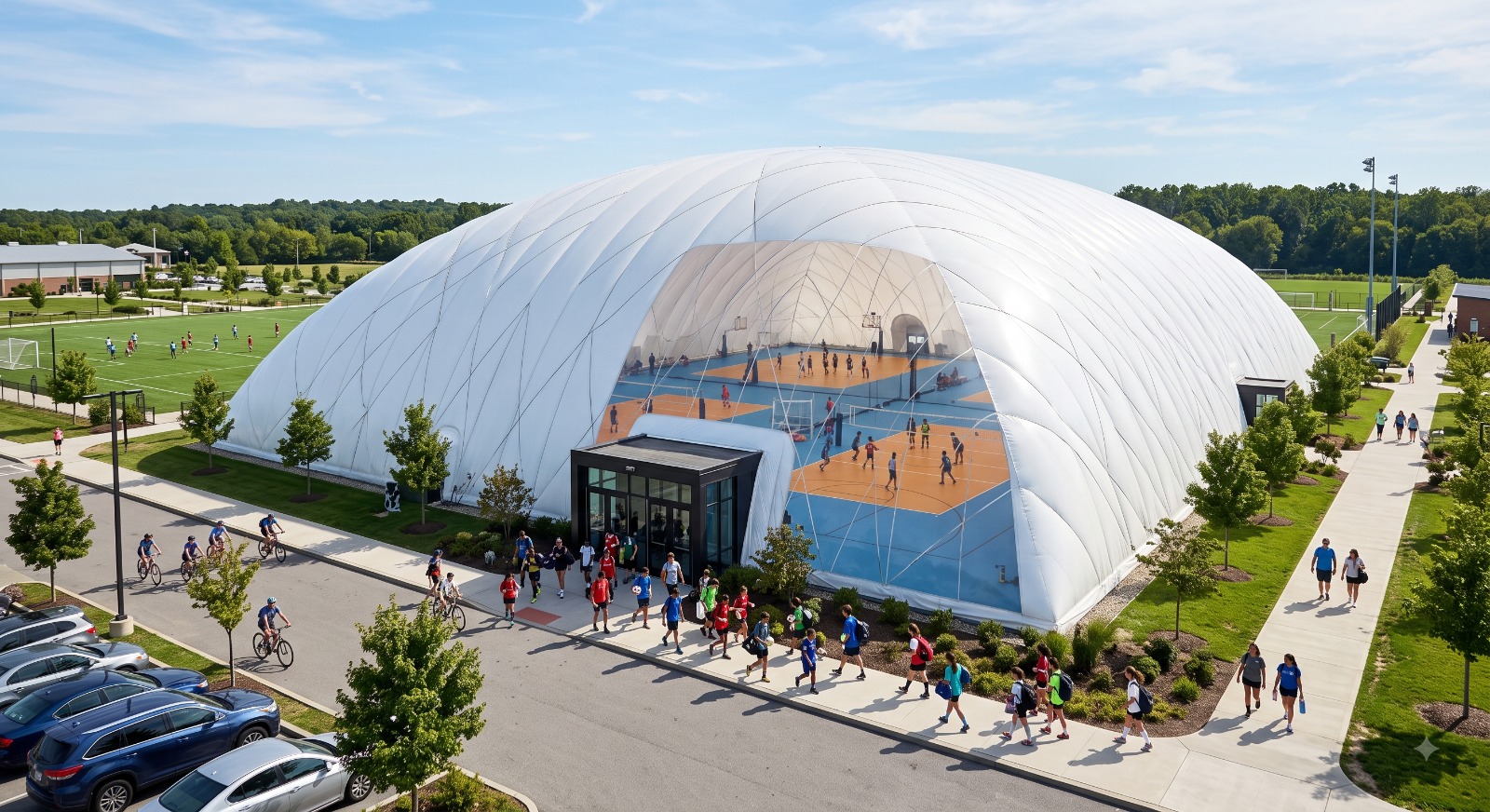
Air Domes for Sports Facilities: Benefits & Design Tips
Air Domes for Sports Facilities: Benefits & Design Tips
Air Dome Sports Facilities in India: Cost, Lifespan and Design Considerations
If you've ever tried to book a badminton court in July or a football turf in the middle of monsoon, you already know the problem an air dome sports facility solves. Weather shuts down outdoor courts for weeks, sometimes months, and a permanent RCC stadium isn't something most clubs, schools, or private operators can justify financially. That gap is exactly where air-supported sports structures have found their footing over the last decade, and increasingly so in India.
The benefits are real, but so are the design decisions that determine whether a dome earns its keep or turns into a maintenance headache. Here's both sides.
Get In TouchThis isn't a niche ask anymore either. Air domes are showing up in city-specific ways across India, largely driven by the local weather problem each region is trying to solve:
- Mumbai and Pune — badminton and tennis courts covered ahead of monsoon, so bookings don't get wiped out for weeks at a stretch
- Delhi-NCR — turfs and multi-sport facilities kept usable through smog season and peak summer heat
- Bengaluru and Hyderabad — land costs push operators toward a lightweight dome instead of a permanent build
- Tier-2 sports complexes — schools and clubs using a dome to open a facility fast without a multi-year construction timeline
Lucky-Tech Membranes has supplied fabric into projects across several of these markets, which is part of why the fabric-sourcing question later in this post matters as much as it does.
What You're Actually Paying For
An air dome isn't a tent with better marketing. It's an engineered membrane envelope — usually PVC or PVDF-coated polyester fabric — held up entirely by a pressure differential created by continuously running blowers. No columns, no trusses, no beams cutting across your sightlines. That single fact is what drives most of the cost math, in both directions.
On the lower end, you're not pouring a slab foundation or erecting steel. A basic anchoring system (ballast, ground anchors, or a perimeter foundation depending on soil and wind load) is dramatically cheaper than what a permanent structure needs. That's the main reason air domes for badminton courts, tennis courts, and multi-sport turfs have become popular with schools and mid-sized sports complexes that need to cover a court quickly without committing capital to a building.
On the other side of the ledger, you're paying for something a conventional shed doesn't need: the blower system itself, plus the electricity to run it around the clock, plus backup power so the dome doesn't collapse during an outage. Add climate control if you're covering a facility that needs to stay usable through Indian summers, and the running cost picture changes.
Rough numbers for an air dome cost in India (and these vary a lot by span, fabric grade, and site conditions): expect the membrane and blower package to be the largest single line item, foundation and anchoring next, and HVAC/backup power after that. For a badminton or tennis-court-sized dome, project costs typically land well below what an equivalent permanent covered structure would run. For larger multi-court or stadium-scale domes, the gap narrows, but the speed of installation — often measured in weeks, not the better part of a year — still tips the economics in the dome's favor for many operators.
How Long Does One Actually Last?
This is the question that decides whether "cheaper upfront" turns into "cheaper overall."
A well-specified PVDF-coated membrane, properly maintained, is commonly rated for 15–25 years of service life, with PVC-coated fabric generally sitting at the lower end of that range and PVDF holding up longer against UV degradation and fabric fatigue. That's not a marketing number pulled from a brochure — it's a function of fabric weight, coating quality, weld quality at the seams, and how consistently the blower system maintains internal pressure. Skimp on any of those and you'll be looking at fabric replacement well before the 15-year mark.
Maintenance is ongoing but not heavy: periodic checks on the blower and backup generator, seam inspection, and fabric cleaning to stop dirt and pollutants from accelerating UV wear. Budget for this the same way you'd budget for HVAC servicing on a conventional building — it's a small annual cost against a large capital saving.
Design Considerations That Actually Matter
Getting the engineering right up front is what separates a dome that lasts two decades from one that needs major rework in year five. The main things to get right:
- Span and shape — circular and elliptical footprints distribute wind and snow load more efficiently than rectangular ones, which is why most indoor sports domes for tennis, badminton, and futsal use a curved shape rather than a boxy one
- Wind and snow load ratings — location-specific and non-negotiable; a coastal site needs different blower redundancy and anchoring than a low-wind inland one, and any credible Air Dome Manufacturer will ask for your site data before quoting, not after
- Blower redundancy — a single blower with no backup is a liability; serious installations run at least one standby blower plus a generator, since even a few minutes of pressure drop in high wind is a real problem
- Fabric grade — this is where the "cheap dome" trap lives; lower-grade PVC costs less upfront but degrades faster under UV and heat, while PVDF-topcoat fabric resists dirt pickup and yellowing far better over the facility's life
- Entry and access — revolving doors or air-lock vestibules keep internal pressure stable while people move in and out, a small detail that becomes a daily annoyance if it's overlooked early
- Interior climate — ventilation and, where needed, cooling or dehumidification aren't optional for a dome used through summer; they're the difference between a usable facility and an expensive greenhouse
Seasonal Cover vs. Permanent Build: When Each Makes Sense
An air dome makes the most sense when you need a seasonal sports cover that can go up before a specific season and, in some cases, come down after — think school sports terms, event-driven installations, or facilities that need to extend usable hours through a hot or wet stretch of the year without a multi-year construction commitment. It also wins when land is leased rather than owned, since a lighter structure with a simpler foundation is easier to justify on a site you may not hold for decades.
A permanent structure starts to make more sense when the facility is meant to run indefinitely at full capacity, when local building codes push you toward permanent construction anyway, or when the operating profile calls for heavy foot traffic and long-term fixed seating that a membrane structure isn't built for.
Most operators land somewhere in between: use the air dome to get the facility open and generating revenue fast, then decide on a permanent build once usage numbers justify it.
Sourcing the Fabric Matters as Much as the Design
The engineering gets the attention, but the fabric is what actually determines whether your dome hits its 20-year mark or needs re-skinning at year eight. Working with an established Fabrics Manufacturers and Supplier in India — one that can show weld testing, UV resistance data, and coating specifications rather than just a swatch and a price — is worth the extra diligence upfront.
Lucky-Tech Membranes works on exactly this side of the project: PVC and PVDF-coated fabric for air-supported sports and industrial structures, produced through a partnership with SIOEN Industries that backs the fabric with the kind of coating and weld-strength testing most quotes leave out. If you're comparing quotes for a sports dome project, it's worth asking any prospective Air Dome Manufacturer exactly which fabric supplier they're sourcing from and what warranty backs the membrane itself — not just the installation.
FAQs
How much does an air dome cost per square foot in India?
It varies with span, fabric grade, and site wind/snow ratings, but the membrane and blower system typically make up the largest share of the budget, followed by foundation work and climate control.
Can an air dome stay up year-round, or is it strictly seasonal?
Both are common. Some facilities keep the dome up permanently once installed; others put it up before peak season and take it down afterward, which is one of the format's biggest advantages over a fixed building.
What happens to an air dome during a power cut?
A properly designed system has a backup generator that kicks in automatically to keep the blowers running. Without redundancy, an extended outage can cause the dome to deflate.
Is PVDF fabric always better than PVC for sports domes?
Not always necessary for shorter-term or budget-constrained projects, PVC can be perfectly adequate. For long-term installations in high-UV climates, PVDF's better weathering usually justifies the higher cost.
How long does installation take?
Most sports-scale air domes go from foundation work to a fully inflated, usable structure in a matter of weeks a fraction of the timeline for a comparable permanent building.
Get Your Free Quote Today!